
Restaurant
A business serving prepared food and beverages to customers.

Dietmar Rabich · CC BY-SA 4.0
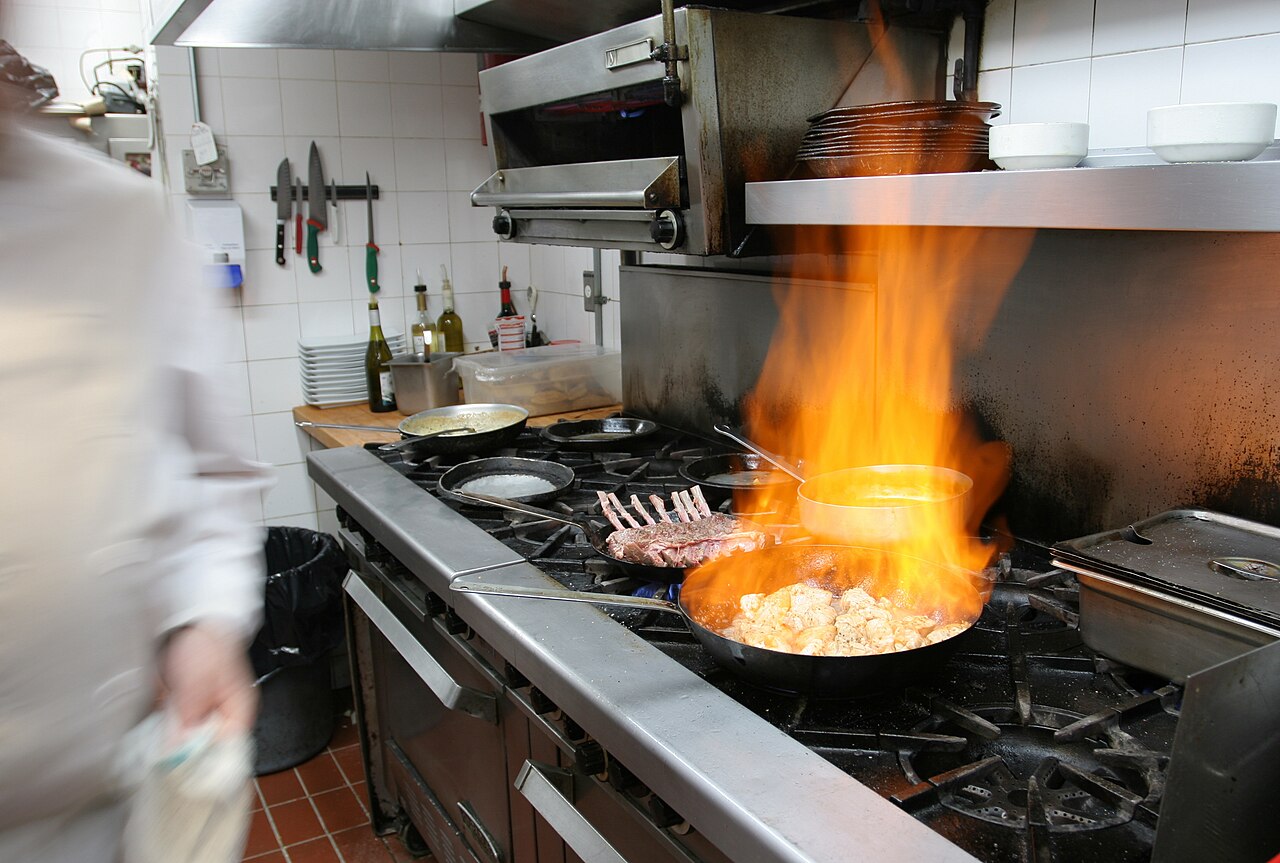
A restaurant is a business that prepares and serves food and beverages to customers. Meals are generally served and eaten on the premises, but many restaurants also offer take-out and food delivery services. Restaurants vary greatly in appearance and offerings, featuring a wide variety of cuisines and service models — ranging from inexpensive fast-food restaurants and cafeterias to mid-priced family restaurants to high-priced luxury establishments.
- field
- Food service and hospitality
- known_for
- Serving prepared meals and beverages to customers on premises or via take-out/delivery
- etymology_origin
- Early 19th century, from French 'restaurer' meaning 'restore to a former state'
Lore & Background
The word 'restaurant' derives from the early 19th century, taken from the French word restaurer 'restore to a former state', literally 'restore to a former state'. The site contained benches, an oven, food preparation areas, and numerous standardized bowls, some preserving traces of food and beer. This site was used by everyday people rather than just elites, featuring large quantities of conical cups and large jars for holding beer, interpreted as evidence of a communal dining space where prepared meals and beverages were served to patrons. A forerunner for the modern restaurant is the thermopolium in Ancient Rome, which sold ready-to-eat food and beverages, similar to modern fast-food restaurants; the Greek equivalent was the kapeleion or taverna. The Romans also had the popina, a wine bar offering simple foods. Early eating establishments recognizable as restaurants in the modern sense emerged in Song dynasty China during the 11th and 12th centuries in cities such as Kaifeng and Hangzhou, where they catered to merchants and locals, offering written menus and waiter service. In Japan, a restaurant culture emerged in the 16th century out of local tea houses. In Europe, inns, taverns, cookshops, and cabarets served food through the Middle Ages and Renaissance.
Reader's Guide
The restaurant as an institution has deep historical roots, with evidence of public food establishments dating back to the third millennium BCE in Sumer. Over millennia, various cultures developed their own versions of eateries, from Roman thermopolia to Song dynasty Chinese restaurants with written menus and specialized service. The modern restaurant concept, particularly the use of the word itself, emerged in 18th-century Paris with establishments serving restorative broths. Restaurants have since become a universal feature of urban life, reflecting and shaping culinary traditions, social interactions, and economic activity. They range from inexpensive fast-food outlets to luxury dining venues, and their evolution mirrors broader societal changes in urbanization, trade, and leisure. The discovery at Lagash underscores that communal dining for non-elites has existed for thousands of years, challenging assumptions about ancient social structures. Restaurants continue to adapt, offering take-out and delivery services alongside traditional dine-in experiences, and remain central to hospitality and culture worldwide.
Did You Know?
- The word 'restaurant' derives from the French word 'restaurer', meaning 'restore to a former state'.
Etymology & the Idea of Restoration
The term "restaurant" carries a surprisingly old conceptual lineage despite its relatively recent entry into English. In the early nineteenth century, the word was borrowed from the French verb restaurer, which originally meant "to provide meat for." Its literal sense — to restore someone to a former state of health or vigor — reveals that the very idea of eating out was once framed as an act of physical renewal. Traces of this meaning appear even earlier: in 1507 the word was used to describe a restorative beverage, and by 1521 it showed up in written correspondence as a reference to something that fortifies the body, a strengthening food or remedy. The fact that it is the present participle of the verb suggests the concept was already in active, everyday use well before it became a label for a type of business. What began as a notion of bodily repair gradually expanded into the broader cultural institution we recognize today: a dedicated space where prepared meals are served to the public, whether on the premises or through take-out and delivery channels.
Ancient Kitchens & the Birth of Public Dining
Excavations in 2023 at the Sumerian city of Lagash, in what is now southern Iraq, pushed the known history of public food service back to roughly 2700 BCE. The site yielded benches, an oven, dedicated preparation areas, and rows of standardized bowls still bearing traces of food and beer. Crucially, researchers noted large quantities of conical cups and big storage jars for beer, pointing to a space used by ordinary residents rather than a royal court. A separate record from 512 BC in Ancient Egypt references a public eating establishment that served a single fixed dish of cereal, wildfowl, and onions. In the Greco-Roman world, the thermopolium filled a role not unlike today's fast-food counter, catering especially to people living in multi-story insulae who lacked private kitchens. Pompeii alone contained 158 such establishments with service counters, clustered along the main thoroughfare and near public gathering spots. The popina, a wine bar offering olives, bread, cheese, stews, sausage, and porridge, served as a social hub for lower-class Romans, some with only standing room, others with tables, stools, or even couches.
The Song Dynasty: A Restaurant Culture Ahead of Its Time
During the eleventh and twelfth centuries, the cities of Kaifeng and Hangzhou in Song dynasty China developed what can be called the first fully recognizable restaurant industry. These establishments grew out of tea houses and taverns that originally served travelling merchants, but they quickly evolved into a sophisticated commercial sector catering to local residents as well. Because merchants from different regions were unfamiliar with local cooking, the restaurants deliberately offered dishes that matched the tastes of visitors from other parts of China. They clustered in entertainment districts alongside hotels, bars, and brothels, and a 1126 manuscript describes patrons being greeted with pre-plated demonstration dishes that functioned as a visual menu. Waiters then sang orders to the kitchen and plated courses in the exact sequence requested. A 1275 account of Hangzhou captures the sheer variety of choices: patrons demanded food hot, cold, tepid, or chilled; cooked, raw, roasted, or grilled. The industry also correlated with the growth of theatrical performance, gambling, and the entertainment trade, and many establishments were operated by families who had fled Kaifeng southward during the Jurchen invasion of the 1120s.
From Kaiseki to Cookshops: Diverse Paths to the Modern Table
Japan's restaurant tradition took a different trajectory, emerging in the sixteenth century from local tea houses. The tea master Sen no Rikyū is credited with creating the kaiseki multi-course meal tradition, and his grandsons later expanded the practice to include speciality dishes and cutlery designed to complement the aesthetic of each course. Across Europe, the medieval and Renaissance periods saw inns, taverns, and cookshops filling the gap for urban residents who lacked the resources to cook at home. In Spain, bodegas served tapas alongside drink; in England, the typical fare included sausage and shepherd's pie. Cookshops offered pies, puddings, sauces, fish, and baked meats, and customers could either purchase a finished meal or bring their own meat to be prepared on site. This patchwork of regional models — from the single-dish Egyptian establishment to the multi-course Japanese kaiseki, from Pompeii's service counters to Hangzhou's sung orders — illustrates that the restaurant has never been a single invention but a continuous, global conversation about how communities gather around prepared food.
Gallery



Frequently Asked Questions
What is a restaurant in the most basic sense?
A restaurant is a hospitality business whose core function is preparing meals and drinks and delivering them to paying customers, either on-site or through take-out and delivery channels.
Where does the word 'restaurant' actually come from?
The term entered common usage in the early 1800s, borrowed from the French verb 'restaurer,' which carries the idea of restoring someone to a previous state—essentially replenishing the body through food.
What kinds of establishments count as restaurants?
The category spans an enormous range, from low-cost fast-food counters and cafeteria-style operations to mid-priced family dining rooms and high-end luxury venues, all unified by the act of serving prepared food and beverages.
Do restaurants only serve food on the premises?
No; while eating in the dining room remains the traditional model, most modern restaurants also handle take-out orders and participate in food-delivery services, extending their reach beyond the physical location.
More in Other 1-21
Spotted an error? Know more?
This is a living reference — every entry is fact-audited, and reader corrections feed straight into our audit queue. Suggest an edit · See this site's audit record