
Squatting
Occupying land or buildings without permission for housing or protest.

Tokorozawa Namiki, Kozo Nakamura · CC BY 4.0
Squatting is the action of occupying an abandoned or unoccupied area of land or a building without the owner's permission, typically for housing. It occurs worldwide, from shanty towns in developing countries to left-wing social centers in industrialized nations, and is often a response to poverty, homelessness, or political activism.
- estimated_global_squatters_2003
- 1 billion
Lore & Background
Squatting historically stems from multiple sources, including the development by anarchist groups such as the Ligue des Anti-propriétaires of the concept of déménagement à la cloche de bois ('silent move-outs'), which transformed individual rent refusal into a collective political act. In many poorer countries, extensive slums or shanty towns arise on city edges, built without legal permission and lacking basic infrastructure like sewerage, electricity, or water. In industrialized countries, squatting often involves left-wing movements—anarchist, autonomist, or socialist—and can serve as a means to conserve buildings or as protest action, creating freespaces, social centers, or pirate radio stations.
Reader's Guide
Squatting is a global phenomenon with diverse motivations and outcomes. In developing countries, it is primarily a survival strategy for the poor and homeless, leading to vast informal settlements like favelas in Brazil or villa miseria in Argentina. In industrialized nations, it can be tied to political movements, as seen in the self-managed social centers of Italy or refugee squats in Athens. The practice is rarely conceptualized in policy or academic debate, according to housing researcher Kesia Reeve. Public attitudes vary: squatting municipal buildings may be treated leniently, while squatting private property often provokes strong negative reactions. Adverse possession, or squatter's rights, allows acquiring title to property through possession for a statutory period in countries like England and the United States.
Did You Know?
- Anarchist author Colin Ward stated that squatting is the oldest mode of tenure in the world.
- In Brazil, there are favelas in major cities and land-based movements in rural areas.
Anatomy & Postural Variations
Squatting is a posture where body weight rests on the feet while knees and hips are bent. Unlike sitting, which transfers load to the ischial tuberosities of the pelvis, squatting keeps the lower buttocks off the ground. The position is remarkably flexible: the angle between the legs can range from fully closed to widely splayed, limited only by the individual's range of motion, and the upper body may tilt forward from the hips to varying degrees. Squatting can be performed as a full or partial movement, and crouching is generally treated as a synonym. A common hybrid involves squatting on one leg while kneeling on the other. Desmond Morris catalogued seven distinct variants, including the flat-footed Asian or Slav squat, the heels-raised Western squat, the squat-kneel, the squat-sit, the legs-fold, the lotus position, and the legs side-curl. In Western culture, equivalents to the Slav squat—sometimes performed with hands pressed together in a prayer shape—have been dubbed the rap squat, prison pose, or jail pose, and are frequently adopted as photographic stances.
Cultural Practice & Everyday Life
Among adults in Chinese, Southeast Asian, and Eastern European communities, squatting frequently replaces both sitting and standing as a default resting posture, particularly when the ground is too dirty or wet for sitting or kneeling. Young children across cultures instinctively adopt the squat, suggesting a natural developmental familiarity with the position. The word itself traces back to Old French esquatir or escatir, meaning to compress or press down, while the specific weight-lifting usage only entered English in 1954. In East Asian contexts—Chinese, Japanese, Korean, and Vietnamese—high-flexion postures like kneeling and squatting are woven into daily activity far more than in North America, where such positions appear mainly in occupational, religious, or leisure settings. A notable biomechanical divide exists: Caucasians tend to flex the forefoot when squatting, keeping the heels raised, whereas East Asians are more likely to maintain a flat-footed stance. Most Western adults struggle to keep their heels grounded during a full squat, a limitation often attributed to shortened Achilles tendons resulting from prolonged chair-sitting and the regular use of heeled footwear.
Exercise & Disciplined Practice
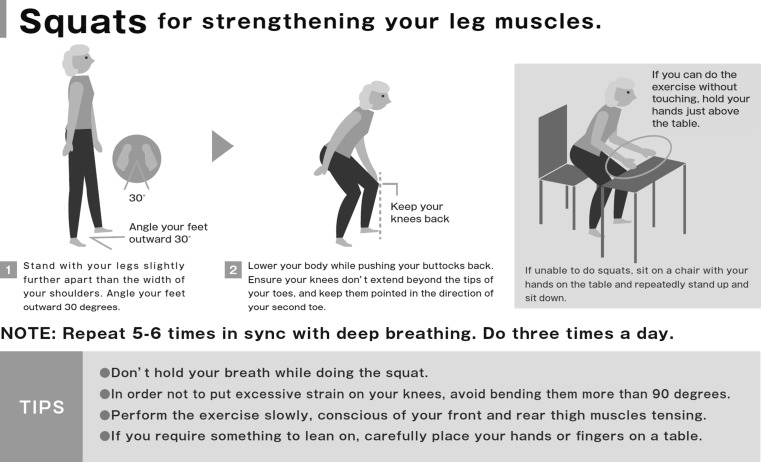
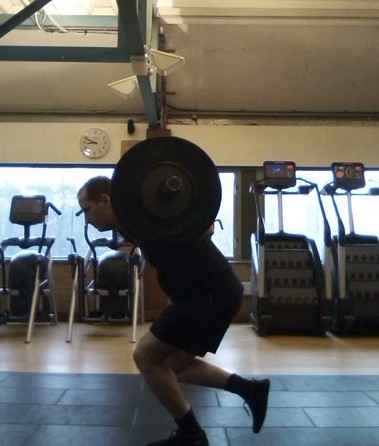
In strength training, the squat functions as a full-body movement that loads the thighs, hips, and buttocks while also reinforcing bones, ligaments, and tendon insertions throughout the lower extremities. A demanding one-legged variation, the pistol squat, isolates a single limb. In yoga, the asana known as Mālāsana or upavesasana—literally the sitting-down pose or garland pose—requires the practitioner to squat with heels flat, feet hip-width or slightly wider apart, toes angled diagonally outward. The torso folds forward between the thighs, elbows rest against the inner knees, and the palms press together in Añjali Mudrā at the chest. Taoist Tai Chi incorporates squatting through the Dan Yu, or spine-stretching, exercise, which targets the pelvic region, legs, and lower back. Practitioners stand with feet wider than the shoulders, and as they descend the knees track in line with the toes. Advanced classes may call for fifty or more consecutive repetitions, making it a sustained test of both muscular endurance and joint stability.
Health, Medicine & the Body's Record
Squatting carries both risks and remarkable therapeutic applications. Prolonged daily squatting over many years is associated with a higher incidence of knee osteoarthritis, and sustained postures can lead to bilateral peroneal nerve palsy, colloquially called squatter's palsy, though other causes may contribute. In societies where squatting is rare, adopting it as an alternative posture may actually confer health benefits. Medically, the squat plays a critical role in managing tetralogy of Fallot: toddlers and older children experiencing a tet spell—a sudden drop in blood oxygen causing blue skin—instinctively squat, which raises systemic vascular resistance, increases pressure on the left side of the heart, and temporarily reduces the right-to-left shunt, allowing more blood to reach the lungs. Skeletal evidence also preserves the habit: squatting facets on the distal tibia and talar surfaces, formed by bone-on-bone contact during extreme dorsiflexion, serve as archaeological markers that a person habitually squatted in life.
Gallery
Frequently Asked Questions
What is squatting?
Squatting refers to the act of taking up residence in a vacant piece of land or an empty building without the property owner's consent. It is most commonly done to secure shelter, though it can also serve as a form of political protest.
Where does squatting typically occur?
It is a worldwide phenomenon, ranging from informal shanty settlements in developing nations to left-wing social centers in industrialized countries. In England and Wales, for example, around fifty thousand people were squatting in the late 1970s.
Why do people engage in squatting?
The primary drivers are poverty, homelessness, and a lack of affordable housing options. In some cases, however, squatting is a deliberate political act meant to challenge property norms or create community spaces.
Is squatting only about finding a place to live?
While securing housing is the most common reason, squatting can also function as a vehicle for activism and social protest. In industrialized nations, it frequently takes the form of occupied buildings used as left-wing social centers rather than purely residential spaces.
More in Other 1-21
Spotted an error? Know more?
This is a living reference — every entry is fact-audited, and reader corrections feed straight into our audit queue. Suggest an edit · See this site's audit record